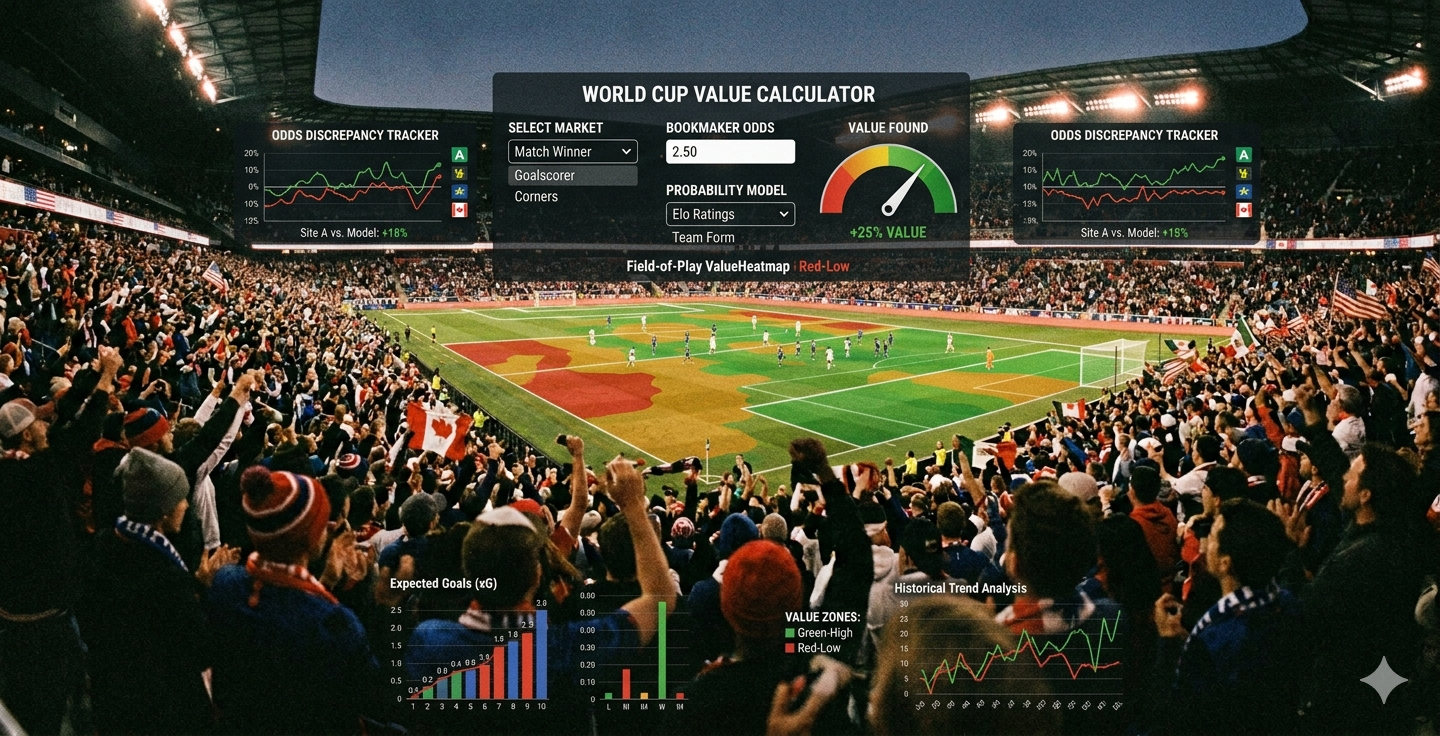
World Cup Stadium-Specific Betting Angles 2026
Not every World Cup stadium plays the same. That matters more than a lot of bettors think. One venue may favor faster tempo. Another may create a louder crowd edge. Another may bring altitude, heat, wind, surface changes, or different ball movement. Same teams, different stadium, different betting read. This guide breaks down how I’d use stadium-specific betting angles for the 2026 World Cup. Simple idea: don’t bet every match like it’s played on the same field.


Key Insights
- Quick Answer: Stadium-specific betting means adjusting your read based on venue conditions like surface, pitch size, altitude, roof, weather, crowd, and familiarity.
- Best Way To Get Better Results: Compare stadium conditions with team style, player roles, market movement, and live match flow.
- Biggest Advantage: You can spot hidden edges when the market prices the teams but underprices the venue.
Why Do Stadium-Specific Angles Matter In World Cup Betting?
Stadium-specific angles matter because the venue can change how the match feels and plays.
For the bigger picture, start with Advanced World Cup Betting Strategy Guide 2026. That pillar guide should be your base for value betting, bankroll control, market timing, futures, props, and live betting.
The 2026 World Cup will be played across Canada, Mexico, and the United States, with FIFA listing 104 matches across 16 host cities. That means bettors will deal with different venues, climates, travel paths, crowd profiles, and playing conditions across the tournament.
That creates betting angles.
A team that thrives in open space may look better on a wider-feeling pitch. A high-pressing team may struggle more in heat or altitude. A crossing-heavy team may lose value if wind or surface conditions hurt delivery. A host-heavy crowd may push tempo, cards, or live odds.
The stadium does not replace team analysis.
But it adjusts it.
The sharper question is not just, “Who is better?”
It’s, “Who is better in this venue, under these conditions, at this price?”
Looking to get an edge throughout the entire World Cup?
Check out Shurzy’s Predictions tool for data-backed picks, matchup insights, and betting angles across every stage of the tournament. Whether it’s group matches or knockout rounds, this is where smart bettors find value.
What Stadium Factors Should Bettors Track?
I’d track the stadium factors that can actually affect betting markets.
The main ones are:
- Pitch size
- Surface type
- Grass quality
- Roof or indoor setup
- Altitude
- Heat and humidity
- Wind exposure
- Rain and drainage
- Crowd noise
- Venue familiarity
- Travel route
- Kickoff time
Some of these affect the full match. Others hit specific markets.
Pitch size may affect pressing and wide play. Surface may affect ball speed and footing. Altitude may affect stamina. Roofed stadiums may reduce weather impact. Crowd noise may affect live momentum, cards, and referee pressure.
FIFA’s stadium guidance lists 105 metres by 68 metres as the recommended field-of-play dimensions, while IFAB’s Laws allow a range for international matches. That means bettors should still think about how a venue actually plays, even when fields meet official requirements. (FIFA Publications)
Tiny differences can matter when betting props, totals, corners, and live markets.
Not always.
But enough to check.
How Can Pitch Size Affect Betting?
Pitch size can affect space.
More space can help teams that switch play, use wide wingers, stretch defensive lines, or attack through transitions. A tighter-feeling pitch can help compact teams, pressing teams, and sides that want to crowd central areas.
For betting, pitch size can affect:
- Totals
- Corners
- Winger props
- Fullback crossing props
- Pressing effectiveness
- Passing volume
- Player shots
- Live tempo
This is where How Pitch Size Impacts World Cup Betting will be useful next. Pitch size deserves its own deeper read because it can shape spacing, pressing, corner volume, and player prop value.
Before betting, I’d ask:
- Does one team need wide space?
- Does one team press better in tighter areas?
- Will fullbacks have room to overlap?
- Are corners more likely from wide pressure?
- Is the market pricing team style but not field feel?
Pitch size is not a magic edge.
But it can make a tactical read stronger or weaker.
How Can Surface Type Affect Betting?
Surface matters because the ball and players interact with it every second.
A fast surface can help quick passing and transitions. A slower surface can hurt tempo and make buildup heavier. A slippery surface can create bad touches, late tackles, and goalkeeper problems.
Surface can affect:
- Passing props
- Dribbling
- Shots
- Corners
- Cards
- Injuries
- Goalkeeper handling
- Live totals
A team that relies on quick one-touch passing may need a clean, quick field. A team that plays direct may care less. A team with explosive wingers may benefit from a fast pitch if footing is good, but lose value if players keep slipping.
The key is not “good surface” or “bad surface.”
The key is how the surface changes each team’s style.
If the pitch helps one team’s strength more than the other’s, that can create betting value.
Want better World Cup bets?
Use Shurzy’s Predictions tool for data-driven picks and insights.
How Can Altitude Change Stadium Betting Angles?
Altitude can affect stamina, pressing, recovery, and late-game performance.
This matters most in higher-elevation venues. Earlier in this batch, we covered Mexico City and other altitude-related reads, but the stadium-specific point is simple: altitude can make normal team ratings less reliable if one team is better adapted than the other.
Altitude can affect:
- High pressing
- Fullback runs
- Sprint-heavy props
- Second-half totals
- Cards
- Corners
- Substitute impact
- Live fatigue reads
A team may look fine early, then fade after minute 55.
That is why altitude is often better as a live betting angle than a pre-match shortcut.
Watch the legs.
Are recovery runs slower? Is the press dropping? Are defenders clearing instead of passing? Are midfield gaps opening?
If yes, the stadium is starting to matter.
How Can Roofed Or Indoor Stadiums Affect Betting?
Roofed or indoor stadiums can reduce some weather uncertainty.
That can matter a lot.
If a venue protects the pitch from rain or wind, the match may play closer to normal conditions. If a stadium has climate control, extreme heat may be less of a factor inside than it would be outdoors.
For betting, indoor or roofed conditions can affect:
- Weather-based totals
- Passing rhythm
- Player props
- Goalkeeper handling
- Wind-related crossing angles
- Heat fatigue reads
- Live market confidence
This does not mean roofed stadiums are always easier to bet.
Crowd noise can feel louder. Surface feel can still matter. Lighting, roof status, and venue setup can still change the match.
But if the public is overreacting to a weather forecast without checking stadium setup, that can create value.
Always ask:
Is the weather actually reaching the field?
If not, the market may be pricing a condition that barely matters.
How Can Stadium Atmosphere Affect Betting?
Stadium atmosphere can affect momentum, referee pressure, and live market movement.
A loud crowd can make a host or popular team feel more dangerous. It can push tempo. It can make every penalty appeal feel bigger. It can increase pressure on an opponent trying to defend deep.
But crowd noise is not the same as chance quality.
For atmosphere, I’d watch:
- Is the crowd pushing real pressure?
- Is the opponent rattled or calm?
- Is the referee calling the match tighter?
- Are cards or corners building?
- Is the live market reacting to noise?
- Are odds moving faster than the actual chances?
This is where bettors get trapped.
The stadium sounds wild, so the home-like team feels like it must score.
Maybe.
But if the team is only taking weak shots from bad areas, don’t overpay.
Atmosphere is a clue.
Not proof.
How Does Group Location Connect To Stadium Angles?
Stadium-specific betting connects directly to group-location strategy.
That’s why World Cup Scheduling Advantage By Group Location fits naturally here. Group location tells you the route. Stadium-specific analysis tells you how each venue on that route may affect performance.
A team may have a clean group path geographically, but still face tough venue conditions. Another team may travel more but land in stadiums that better suit its style.
So I’d combine:
- Venue location
- Travel distance
- Rest days
- Climate
- Surface
- altitude
- Crowd profile
- Team style
That gives you a better match read than checking the teams alone.
The World Cup is not played on a spreadsheet.
It’s played in specific stadiums.
That detail can matter.
How Can Stadium Angles Affect Player Props?
Player props are often where stadium angles show up clearly.
A wider-feeling pitch can help wingers and fullbacks. A fast surface can help through-ball runners. A heavy surface can hurt sprint-heavy players. Altitude can reduce late pressing output. Wind can hurt crossing props.
Before betting player props, I’d ask:
- Does the venue help this player’s role?
- Does the surface support his output?
- Does the stadium hurt crossing or long balls?
- Does altitude increase sub risk?
- Does crowd pressure increase card risk?
- Is the prop based on averages from different conditions?
A player’s average is useful.
But stadium conditions can make that average less reliable.
That’s especially true for shots, crosses, passing, cards, saves, and substitution-sensitive props.
How Can Stadium Angles Affect Live Betting?
Live betting is where stadium-specific reads become strongest.
Pre-match, you can study the venue.
Live, you can see how it plays.
After 10 to 15 minutes, I’d ask:
- Is the pitch fast or slow?
- Are players slipping?
- Is the ball moving cleanly?
- Is crowd pressure affecting tempo?
- Is wind reaching the field?
- Is altitude or heat showing early?
- Did the market adjust?
Then check again after minute 55.
That is where fatigue-based stadium angles become clearer.
If a team fades because of altitude, heat, surface, or travel, the live board may offer better entries than pre-match markets.
Don’t force the stadium angle before the match proves it.
Let the venue show itself.
Then bet the market that reflects it best.
What Are The Biggest Stadium-Specific Betting Mistakes?
The biggest mistake is treating every venue like a neutral copy-paste field.
It isn’t.
Other mistakes include:
- Ignoring surface and pitch feel
- Overreacting to crowd noise
- Ignoring roof or indoor setup
- Betting weather without checking stadium exposure
- Ignoring altitude
- Betting player props from averages only
- Assuming stadium edges guarantee winners
- Missing live venue clues
- Forgetting the price
That last one matters most.
A stadium angle only creates value if the market has not priced it correctly.
If everyone knows the venue edge and the line already moved, the edge may be gone.
Good angle. Bad number.
Pass.
What Is A Simple Stadium-Specific Betting Checklist?
Here’s the quick process I’d use.
First, identify the venue.
Next, check pitch size, surface, altitude, roof, weather exposure, and crowd profile.
Then match the venue to team style. Pressing, possession, crossing, counterattacks, low block, or direct play?
After that, check player props. Who benefits? Who loses value? Who may face card or sub risk?
Then compare the market. Did odds already adjust?
Then watch live.
Is the stadium actually changing the match?
Finally, check price.
If the stadium creates a real edge and the market has not caught up, maybe there’s value.
If not, pass.
No forced venue bets.
Where To Go Next
If you want to start with one of the most basic venue factors, read How Pitch Size Impacts World Cup Betting next. It breaks down how field dimensions, spacing, pressing, wide play, corners, props, and live tempo can affect betting value.
Before you bet the World Cup, check Shurzy’s Predictions for the best betting angles and value plays.
FAQ
Do Stadiums Affect World Cup Betting?
Yes. Stadiums can affect betting through pitch size, surface, altitude, weather exposure, roof setup, crowd noise, venue familiarity, props, totals, cards, corners, and live odds.
What Stadium Factors Matter Most For Betting?
Pitch size, surface type, grass quality, altitude, roof or indoor setup, weather exposure, crowd atmosphere, and travel route matter most.
Can Stadium Conditions Affect Player Props?
Yes. Stadium conditions can affect shots, crosses, passing, cards, saves, corners, tackles, and substitution risk.
Does A Roofed Stadium Change Weather Betting?
Yes. A roofed or indoor setup can reduce the impact of wind, rain, heat, or pitch weather depending on the venue conditions.
What Is The Biggest Stadium Betting Mistake?
The biggest mistake is betting every match like the venue is neutral without checking pitch, surface, weather exposure, crowd, altitude, live flow, and price.

Minimum Juice. Maximum Profits.
We sniff out edges so you don’t have to. Spend less. Win more.


RELATED POSTS
Check out the latest picks from Shurzy AI and our team of experts.