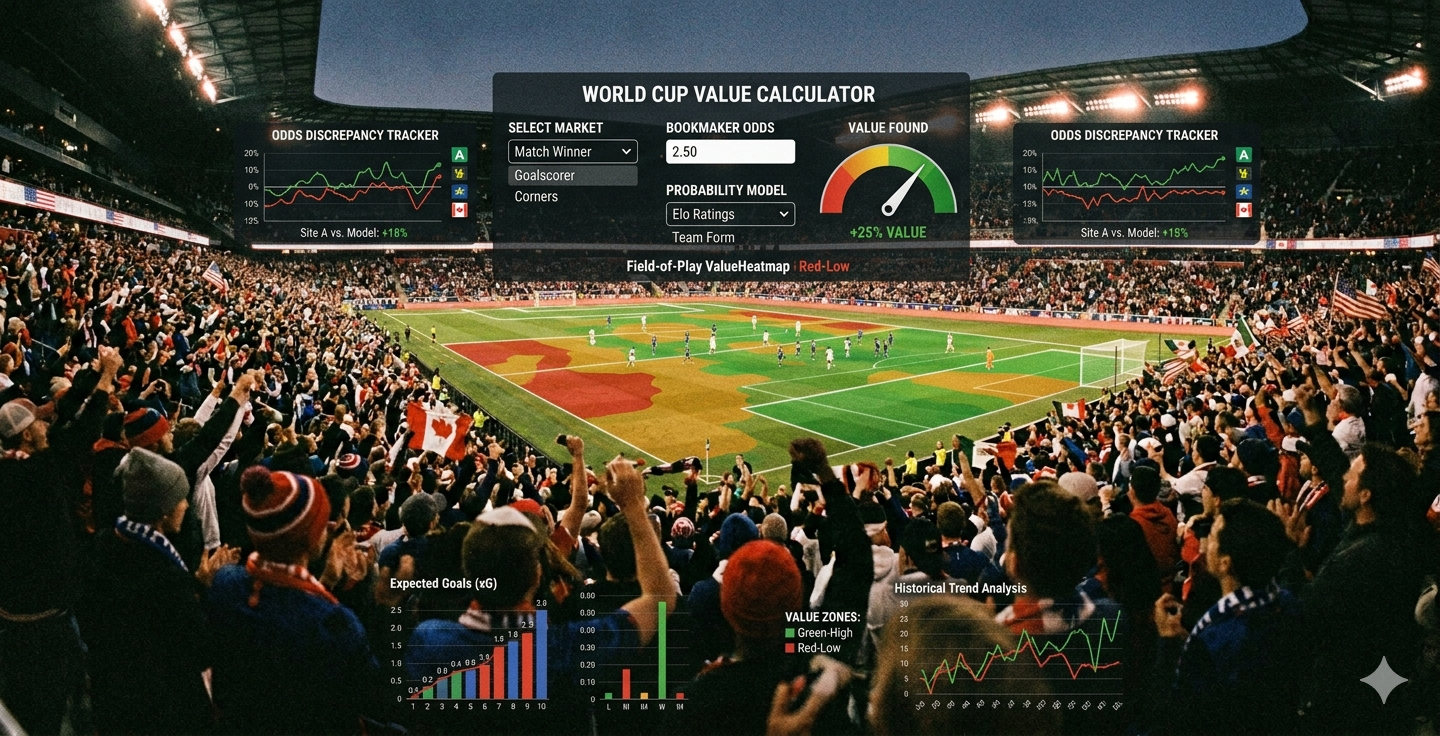
World Cup Multi-Country Hosting Impact On Betting 2026
The 2026 World Cup is not a normal host setup. It’s not one country, one climate, one travel pattern, or one clear home advantage. Canada, Mexico, and the United States are sharing the tournament. That means different venues, different crowd profiles, different travel demands, and a lot more moving parts for bettors. This guide breaks down how I’d bet the multi-country hosting impact in 2026. Not by overcomplicating it. Just by asking which team is more comfortable, better rested, and less overpriced by the market.


Key Insights
- Quick Answer: Multi-country hosting matters because travel, climate, venue familiarity, and crowd support can vary heavily from match to match.
- Best Way To Get Better Results: Compare each team’s venue path, travel load, climate adjustment, and crowd setup before betting.
- Biggest Advantage: You can spot where the market is pricing team strength but missing the actual tournament conditions.
Why Does Multi-Country Hosting Matter In World Cup Betting?
Multi-country hosting matters because the 2026 World Cup is spread across three host countries, not one.
For the bigger picture, start with Advanced World Cup Betting Strategy Guide 2026. That pillar guide should be your base for value betting, bankroll control, timing, futures, props, and live betting.
FIFA confirms that the 2026 World Cup has three host countries: Canada, Mexico, and the United States. FIFA also lists 16 host cities and a 104-match schedule for the expanded tournament.
That setup creates a different betting puzzle.
A team might play one match in cooler conditions, then move into heat. Another might deal with altitude. Another might get a friendly crowd in one venue and a more neutral crowd in the next.
So when I’m betting 2026, I’m not only asking, “Who is better?”
I’m asking, “Who handles this route better?”
That route includes travel, rest, climate, crowd, surface, venue comfort, and market hype.
Same team.
Different country.
Different betting read.
Looking to get an edge throughout the entire World Cup?
Check out Shurzy’s Predictions tool for data-backed picks, matchup insights, and betting angles across every stage of the tournament. Whether it’s group matches or knockout rounds, this is where smart bettors find value.
What Makes Multi-Country Hosting Different?
A single-country World Cup can still have different cities and climates. But multi-country hosting adds more layers.
Teams may cross borders, move through wider travel routes, and adjust to different conditions more often. Crowds can change too. A match in Mexico may feel very different from a match in Canada or the United States.
For bettors, that can affect:
- Travel fatigue
- Rest and recovery
- Climate adjustment
- Altitude comfort
- Crowd support
- Venue familiarity
- Team rotation
- Player props
- Live betting tempo
- Futures path value
This is not just a geography note.
It can affect performance.
A team that looks strong in one venue may not look the same after a long trip, shorter rest, and different conditions.
That does not mean auto-fade.
It means check whether the odds still match the setup.
How Can Travel Change Betting Value?
Travel is one of the biggest multi-country hosting angles.
A team that moves across long distances between matches may deal with recovery issues. Another team with a cleaner regional path may keep better rhythm.
That’s why World Cup Travel Distance Impact On Team Performance fits naturally here. Travel distance is one of the first things I’d check before pricing any multi-country hosting edge.
Travel can affect:
- Pressing intensity
- Late-game stamina
- Defensive recovery
- Passing sharpness
- Substitution timing
- Player prop minutes
- Live betting value
But travel only matters if it creates a real gap.
Everyone travels during a World Cup. The edge comes when one team’s travel is tougher than the other’s and the market does not fully price it.
Long travel plus short rest?
Interesting.
Long travel plus heat or altitude?
Very interesting.
Long travel after extra time?
Now I’m really paying attention.
How Can Climate Zones Affect Match Betting?
The 2026 tournament can create very different climate reads depending on the venue.
Heat, humidity, altitude, wind, rain, and cooler conditions can all affect how teams play.
A high-pressing team may not press as hard in tough heat. A team used to cooler conditions may struggle in humidity. A team that relies on crosses may have issues in wind. A team playing at altitude may need to manage energy differently.
The important part is style.
Climate does not hurt every team the same way.
I’d ask:
- Does this team rely on pressing?
- Does this team need fast transitions?
- Does this team play patiently enough to manage heat?
- Does the opponent handle the condition better?
- Did the total already move?
- Are player props still based on normal output?
A weather or climate edge can show up in totals, live betting, cards, corners, and player props.
Not just the moneyline.
Sometimes the best climate bet is a second-half fade of tired legs.
Sometimes it’s under early, over late.
Messy, but useful.
How Can Multi-Country Hosting Affect Host Advantage?
Host advantage in 2026 is not one thing.
Canada, Mexico, and the United States may each have different home-style edges. The crowd, venue, climate, and public betting pressure can all vary.
Mexico may have different climate or altitude comfort in certain venues. The United States may get huge crowds and public betting attention. Canada may have stronger comfort in cooler conditions.
But none of that is automatic.
Host teams can still be overpriced.
So for each host match, I’d ask:
- Is this a real home crowd?
- Is the venue familiar or comfortable?
- Does the opponent also have strong fan support?
- Did the host price shorten too much?
- Is the host actually creating chances?
- Are props inflated by public attention?
Host advantage is useful only when the number still makes sense.
No free points for vibes.
Want better World Cup bets?
Use Shurzy’s Predictions tool for data-driven picks and insights.
How Can Venue Rotation Affect Player Props?
Venue rotation can quietly affect player props.
A player’s normal role may look strong, but travel, climate, and rest can change his output.
A winger who relies on sprints may be less effective after heavy travel. A midfielder may see fewer passes if his team plays more direct in tough conditions. A defender may become more card-prone if fatigue hits late.
For props, I’d check:
- Expected minutes
- Travel load
- Climate adjustment
- Sprint-heavy role
- Set-piece role
- Substitution risk
- Venue conditions
- Match tempo
This is where bettors can avoid bad overs.
A player’s average line may look good, but the venue path may make it weaker.
On the flip side, venue rotation can create value for backups or fresh substitutes. A player coming off the bench against tired defenders can become interesting live.
Not always pre-match.
Sometimes the better angle appears after minute 60.
How Can Multi-Country Hosting Affect Totals?
Totals can be very sensitive to venue conditions.
A match in tough heat may start slower. A match with tired defenses may open late. A match with heavy travel on both sides may lack sharpness. A match where one side adjusts better may tilt hard in the second half.
For totals, I’d ask:
- Are both teams fresh?
- Is one team more travel-worn?
- Does climate slow attacking tempo?
- Does fatigue create defensive mistakes?
- Are substitutions likely to change pace?
- Did the market already adjust?
No lazy rule.
Multi-country hosting does not automatically mean more goals or fewer goals.
It means the normal team read needs a conditions check.
If both teams are tired and cautious, under may be live.
If one team fades badly, second-half over or opponent team total may be better.
Same match. Different timing.
How Can Multi-Country Hosting Affect Futures?
Futures betting gets more interesting with multi-country hosting because the route matters.
A team’s chance to go deep is not only about quality. It is also about group location, travel path, rest, depth, and adaptation.
A deep squad may handle venue changes better. A thinner squad may struggle if starters keep logging heavy minutes. A team with flexible tactics may adjust better to different climates.
For futures, I’d check:
- Group venue sequence
- Knockout travel path
- Climate shifts
- Altitude risk
- Squad depth
- Recovery windows
- Possible hedge points
A team with a smoother route may become more valuable than a slightly stronger team with a brutal path.
That’s not sexy.
But futures betting is not about picking the prettiest team.
It’s about price plus path.
How Can Live Betting Confirm Hosting Impact?
Live betting is one of the best ways to confirm whether multi-country hosting is actually affecting the match.
Pre-match, you can predict travel and climate impact.
Live, you can see it.
After 10 to 15 minutes, I’d ask:
- Is one team pressing normally?
- Does either side look heavy?
- Are passes sharp?
- Are players slipping or mistiming touches?
- Is the crowd affecting tempo?
- Is the live market overreacting?
- Are cards or corners cleaner than the side?
Then I’d check again after 55 to 70 minutes.
That’s usually when travel and climate edges get louder.
Tired legs. Late tackles. Bad clearances. Slow recovery runs.
That’s where live value can show up.
What Are The Biggest Multi-Country Hosting Betting Mistakes?
The biggest mistake is treating every venue like the same neutral field.
It’s not.
Other mistakes include:
- Ignoring travel sequence
- Treating all host teams the same
- Ignoring climate and altitude
- Assuming crowd support is automatic
- Betting player props without checking venue impact
- Using old team averages without condition adjustment
- Ignoring live fatigue signs
- Overreacting to host narratives
- Forgetting the price
That last one again.
A travel or venue edge only matters if the market has not fully priced it.
If everyone already saw it and the line moved, the edge may be gone.
Good angle. Bad number.
Pass.
What Is A Simple Multi-Country Hosting Checklist?
Here’s the quick process I’d use.
First, identify the venue and country.
Next, compare travel distance, rest days, and previous match workload.
Then check climate, altitude, weather, and kickoff time.
After that, look at crowd setup. Host-heavy, mixed, or mostly neutral?
Then match those factors to team style. Pressing, possession, crossing, counterattacks, or low block?
Finally, compare everything to the price.
If the conditions create a real edge and the market has not reacted, maybe there’s value.
If not, pass.
No need to force a geography angle.
Where To Go Next
Read World Cup Venue Rotation And Travel Fatigue Angles next. It breaks down how moving between stadiums, regions, climates, and rest windows can create fatigue-based betting value throughout the tournament.
Before you bet the World Cup, check Shurzy’s Predictions for the best betting angles and value plays.
FAQ
Why Does Multi-Country Hosting Matter In World Cup Betting?
Multi-country hosting matters because teams may face different travel routes, climates, crowds, venues, and recovery demands across the tournament.
Will The 2026 World Cup Have Three Host Countries?
Yes. FIFA confirms Canada, Mexico, and the United States are the three host countries for the 2026 World Cup. (FIFA)
Can Multi-Country Hosting Affect Player Props?
Yes. Travel, climate, rest, fatigue, venue conditions, and substitution risk can all affect player prop value.
Does Multi-Country Hosting Always Help Host Teams?
No. Host teams can benefit from crowd and comfort, but they can also be overpriced by public betting hype.
What Is The Biggest Multi-Country Hosting Betting Mistake?
The biggest mistake is treating every match as neutral without checking travel, climate, crowd support, venue conditions, and price.

Minimum Juice. Maximum Profits.
We sniff out edges so you don’t have to. Spend less. Win more.


RELATED POSTS
Check out the latest picks from Shurzy AI and our team of experts.