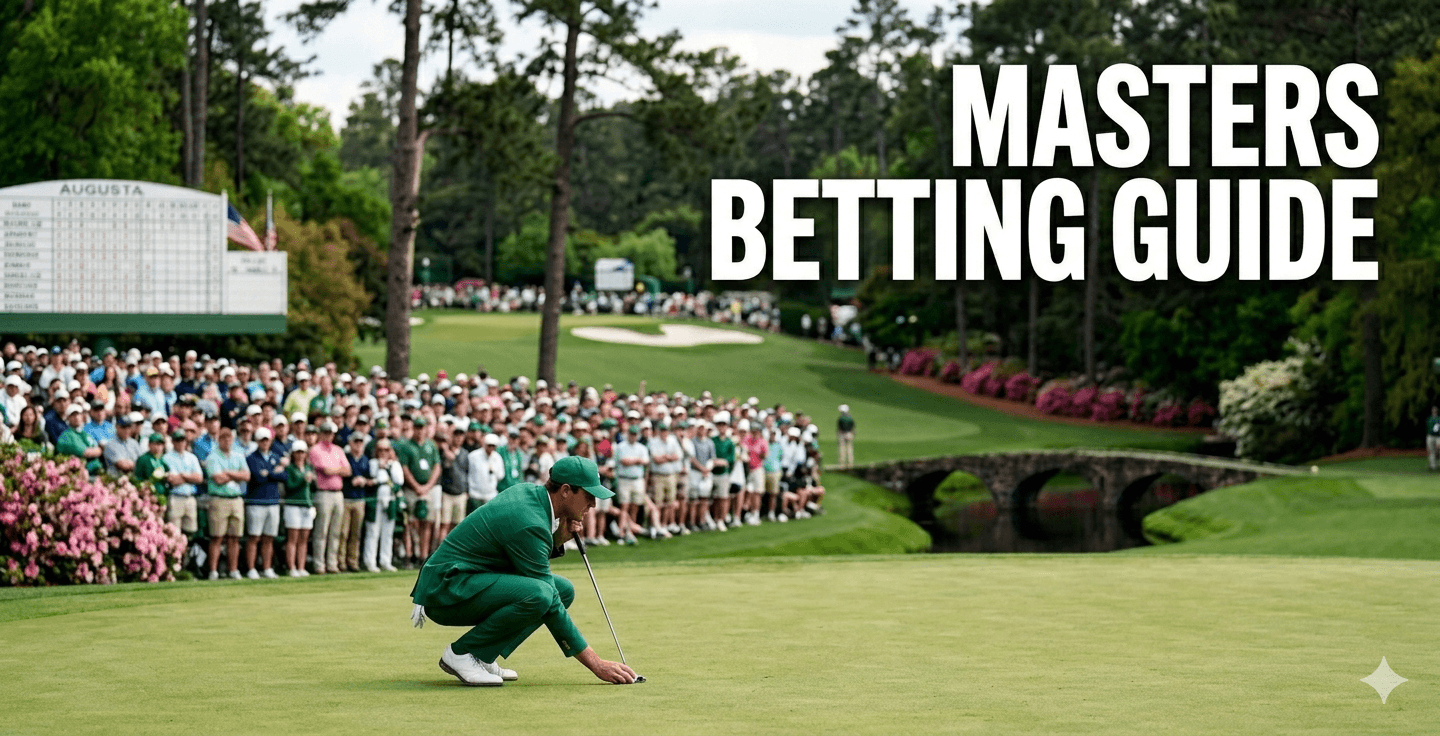
Who Will Win the Masters? A Data-Backed Prediction Framework
A simple five-signal checklist to help you answer who will win the Masters: recent form, iron play, Augusta fit, short game, and price—plus a quick way to turn it into a tight betting card.


Who will win the Masters? If you’re staring at the outright board and feeling overwhelmed, you’re not alone.
Most bettors start with the shortest odds and the biggest names. But Augusta National usually rewards a pretty repeatable player profile, not just hype.
This isn’t a spreadsheet party. You don’t need 20 stats to make a smart bet.
In this guide, we’ll use a simple five-signal framework to cut the field down fast.
Think of it like a quick pre-bet checklist. You’re trying to spot the guys who can handle the slopes, the speed, and the pressure—and then see if the number is worth it.
We’ll walk through recent form, iron play, Augusta fit, short game, and price—then show how to turn that into a clean three-man shortlist. By the end, you’ll know exactly what to look for.
Want better bets?Check out Shurzy’s Live Odds, Player Props, and Predictions for real-time insights and smarter wagering decisions.
The quick answer: the Masters winner profile is usually pretty clear
Most years, the most likely Masters champ is an elite tee-to-green player who shows up in strong form, cashes in on the par 5s, and doesn’t give shots away around the greens. That’s the masters winners profile in a nutshell.
- Hot recent form
- Sharp iron play
- Strong par-5 scoring
- Steady short game and bogey control
- Enough Augusta comfort to avoid big mistakes
You don’t need a guy to be the best putter on earth. You need someone who keeps giving himself chances and doesn’t melt down when Augusta bites back.
Players who hit four or five boxes deserve most of your attention.
Takeaway: Four boxes gets you interested; five boxes gets you betting.
Read more: PGA Tour Golf: Masters Betting Guide 2026
Signal 1: recent form matters more than old reputation
Start with the last five to eight starts. If a player is making cuts, showing up on leaderboards, and playing solid on the weekend, that’s real form. If he’s missing cuts or shooting one big number every week, that’s a warning sign.
Form doesn’t mean “won last week.” It means the swing and the confidence look stable. At Augusta, you can’t show up searching for your game on the range.
What to check: steady made cuts, a couple top-20s, and no recent Thursday-or-Friday faceplants.
Big-name value is fake value if the player has looked flat for a month.
Takeaway: Cold players can still win—but they need a much bigger price before you bite.
Read more: Who Will Win the Masters? A Data-Backed Prediction Framework
Signal 2: Iron play is the big one
Iron play is the big one at Augusta. Most Masters weeks aren’t won with a miracle putter—they’re won with clean second shots that keep the ball on the right side of the green.
Augusta’s greens are fast and tilted. If you’re hitting long, short, or on the wrong level, you’re suddenly putting to survive, not to make birdies. Strong approach play keeps pressure on your competitors instead of on your short game.
When a player is dialed in with his irons, he keeps giving himself birdie chances and avoids the nasty misses that lead to double bogeys. It’s not flashy, but it travels.
Par-5 scoring is the sidekick. If a guy can’t take advantage of the four par 5s, he’s basically asking to chase the leaders all week.
What to check: recent approach form (are his irons trending?), greens hit (is he giving himself putts?), and par-5 scoring.
Takeaway: If the irons look sharp, don’t overthink the rest.
Signal 3: Augusta fit matters, but do not overdo course history
Augusta is one of the few places where course history actually means something. The slopes, the sight lines, and the green speeds are just different.
Some guys get impatient and force shots at pins that don’t want to be attacked. Others take their medicine, play the right side of the green, and wait for chances on the par 5s.
Still, don’t let one old top-5 finish do all the work. Good Augusta fit looks like comfort on fast greens, patience after a bad bounce, and smart misses that leave makeable up-and-downs.
Use history as a tiebreaker, not a crutch. If two players look close on recent form and iron play, lean toward the one who’s already proved he can keep his head here.
Takeaway: Trust the skill first, then let Augusta comfort break ties.
Signal 4: short game and bogey control separate contenders from almost-guys
Nobody stripes it for four straight days at Augusta. Even the best ball-strikers miss greens and end up in weird spots.
You don’t have to chase every putting stat. Just ask: does this player regularly get up-and-down, and does he keep bogeys on a leash? Those traits travel to Augusta.
That’s where short game and bogey control show up. The real contenders save par, avoid doubles, and don’t let one bad hole turn into three.
In fan terms: this is the part that keeps a good pick from becoming a Friday headache. If a player needs a perfect ball-striking week to contend, he’s a riskier outright than a guy who can scramble and stay calm.
Takeaway: Back golfers who can survive the messy moments.
Signal 5: the most likely winner is not always the best bet
This is where betting starts. The most likely winner isn’t always the best bet. If the price is too short, you can be right about the player and still lose money.
I like three simple buckets:
- Pay-up favorite (fair price)
- Mid-range value (best balance)
- Longshot sprinkle (tiny stake)
Made-up example: if your top fit is 8-1 but feels like 12-1, pass. If another guy is 30-1 but feels like 18-1, that’s value.
Read more: Best DraftKings Masters Lineup: Sample Builds for Different Contest Types
Betting takeaway: Your masters best bets live where fit meets a good number.
Final shortlist: one favorite, one value play, one longshot
So who will win the masters? Here’s the clean way to build a three-man card without guessing. On publish day, swap in real names based on the five signals above.
Favorite (best for cautious bettors): [Insert the top-market favorite who checks 4–5 boxes]. You want elite iron play, solid recent form, and enough Augusta comfort to stay patient when things get weird.
Value play (best outright value): [Insert a mid-range price golfer with hot approaches]. This is usually the guy who’s trending quietly—lots of greens hit, good par-5 scoring, and fewer blow-up holes.
Longshot (fun small-stake sprinkle): [Insert a longer price with real upside]. Don’t chase a pure miracle; chase a player who can gain shots with irons and scramble when he misses.
One strong opinion plus one smaller upside shot is usually smarter than five random outrights.
Takeaway: Build a tight card, then let Augusta do its thing.
Read more: Masters Cut Line Betting: How to Think About Weekend Value
Final thoughts
If you keep it simple, the Masters handicap gets a lot easier: form, irons, Augusta fit, short game, and price. You’re not trying to predict golf perfectly. You’re just trying to narrow the board the smart way, then bet the numbers that make sense.
And remember: this is entertainment first. Keep your stakes reasonable, keep your card small, and enjoy the sweat on Sunday. A tight plan beats a pile of random longshots.
House tip: If you can’t explain your outright in two sentences, you probably don’t like it enough.
Read more: Masters Full Field Odds: How to Spot Value Beyond the Favorites

Minimum Juice. Maximum Profits.
We sniff out edges so you don’t have to. Spend less. Win more.


RELATED POSTS
Check out the latest picks from Shurzy AI and our team of experts.