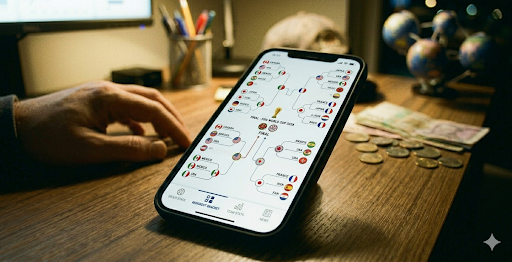
World Cup Betting Market Inefficiencies Guide 2026
2022 World Cup. Group stage. Saudi Arabia vs Argentina. Before the game, Argentina were priced like a foregone conclusion. Every model, every talking head, every casual bettor had Argentina winning comfortably. The market was basically a formality. Saudi Arabia won 2-1. Now I'm not saying you should have backed Saudi Arabia. The result was wild. But here's what's interesting. The closing line on Saudi Arabia plus the handicap was actually decent value for anyone who had looked at how Saudi Arabia set up defensively in their qualifiers versus high-possession teams. The market wasn't looking at that. The market was looking at Messi. That gap between what the market sees and what's actually there is an inefficiency. And a 48-team, 104-match World Cup creates more of them than any other tournament on the planet.


Why inefficiencies exist at all in a huge event
You'd think a tournament this size would have perfectly priced markets. More attention, more money, tighter lines.
Partly true. For Brazil vs Argentina, yes. The market is sharp. The line is close to correct. There's not much room.
But books cannot give equal attention to every match in a 104-game tournament. A group game between two teams nobody outside their own countries cares about gets a fraction of the analytical resources that a marquee match receives. Those games get priced from generic team rating models and not much else.
That's your first inefficiency. Right there.
Read More: The Complete Guide to World Cup Betting 2026
The main sources of mispricing in 2026
The 48-team expansion and tournament debutants
New teams at their first World Cup have almost no usable historical data for pricing models. Books are essentially guessing based on recent qualifying results and regional rankings. Public money hasn't distorted the lines yet because casual bettors aren't paying attention.
Early group games involving debutant nations against mid-tier opponents are some of the most inefficiently priced matches of the entire tournament. Not because the outcome is predictable. Because the lines haven't been properly stress-tested yet.
Public bias toward big names
Books know that emotional money piles onto Spain, France, England, Brazil, and Argentina constantly. Patriotic bettors, casual fans picking their favourite teams, people betting the narrative rather than the number. That volume pushes prices on big nations shorter than they should be in some markets.
The other side of that coin? The teams playing against them are sometimes slightly overpriced because nobody is backing them. That's where value hides.
Props and derivative markets
Corners. Cards. Player shots. Assists. These markets are priced from baseline models and adjusted minimally for specific tactical matchups or referee tendencies. They receive far less scrutiny than main match odds.
A referee known for heavy card volume in a match between two physical teams. A corners market that doesn't account for how aggressively one coach uses corner kicks as an attacking weapon. These are real edges sitting in plain sight.
Looking to get an edge throughout the entire World Cup? Check out Shurzy's Predictions tool for data-backed picks, matchup insights, and betting angles across every stage of the tournament. Whether it's group matches or knockout rounds, this is where smart bettors find value.
Where inefficiencies hide most consistently
Based on how markets get built and where attention flows, the most reliably inefficient spots are:
Non-glamour group games
Games between two teams outside the traditional powerhouses. Low public interest, generic pricing models, less sharp money flowing through. If you have genuinely better information about how one of those teams plays, your edge is real.
Group qualification futures
The new third-place advancement rules create complex probability trees. Some to-qualify and group-winner prices lag significantly once the draw is known and schedules are set. If you run basic group simulations yourself, you'll occasionally find prices that haven't caught up with the actual math.
Second and third-round props
As the tournament progresses, books adjust main market prices quickly but derivative markets sometimes lag. Live cards and corners props in the knockout rounds can be slow to reflect in-game tactical shifts that are obvious to anyone watching.
How to actually hunt these edges
You don't need to be a quant. Seriously.
Here's a lightweight process that works:
Build simple team strength ratings using recent competitive results, xG data, and defensive records against similar opposition. Nothing fancy. Just your own read on each team.
Convert those ratings into win, draw, and loss probabilities for specific matchups. Then compare to what the market is implying from the odds.
Look for gaps. Teams your read rates significantly higher or lower than the market. Totals lines that don't match the combined attacking and defensive profiles you see. Group advancement prices that seem disconnected from the actual schedule and likely opponents.
When the gap between your read and the market price is meaningful, that's your bet. When it's not, pass.
The discipline to pass on everything that doesn't show a genuine gap is what separates this from just betting more games.
Want better World Cup bets? Use Shurzy's Predictions tool for data-driven picks and insights.
Prediction markets as a second opinion
Prediction markets price outcomes based on crowd probability rather than sportsbook models. They're not always right. But they're a useful cross-check.
When prediction market probabilities diverge noticeably from sportsbook implied probabilities on the same outcome, one of them is likely mispriced. Sometimes it's the prediction market. Sometimes it's the book. Comparing them gives you a second data point before you decide.
This is advanced use and not essential for most bettors. But if you're serious about finding inefficiencies, it's worth keeping in the toolkit.
Guardrails before you get too excited
The market is mostly efficient on high-profile matches and main outrights. The inefficiencies in 2026 are real but they're not enormous. You're looking for consistent small edges across a large number of bets, not magical arbitrage opportunities on every game.
The goal is never to find a lock. The goal is to consistently bet where your estimated probability is meaningfully better than what the market is implying. Over a full tournament, that habit compounds into real positive returns.
One good edge, applied consistently, beats ten mediocre bets made on narrative.
Before you bet the World Cup, check Shurzy's Predictions for the best betting angles and value plays.

Minimum Juice. Maximum Profits.
We sniff out edges so you don’t have to. Spend less. Win more.


RELATED POSTS
Check out the latest picks from Shurzy AI and our team of experts.