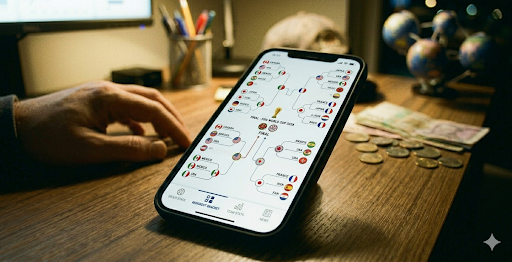
World Cup Predictive Models for Betting 2026
Before the 2018 World Cup I spent about a week reading every predictive model I could find. Supercomputer brackets. Power ranking simulations. Monte Carlo outputs a percentage chance for every team to win the tournament. Germany had somewhere between a 20% and 25% chance to win according to most of them. Defending champions. Deep squad. Strong manager. Germany went out in the group stage. Finished last in their group. Historic embarrassment. The models weren't stupid. Germany genuinely were a strong team. The models just couldn't account for how badly that specific group of players had deteriorated, how much internal tension existed, and how Korea would press them into oblivion in the 90th minute. Models are tools. Not oracles. Here's how to use them correctly.


What predictive models actually do
There are three main types floating around before every major tournament.
Rating-based models
These use systems like Elo ratings or power rankings built from recent competitive results. They adjust for home advantage, recent form, and sometimes injuries. Clean, simple, good baseline.
Expected goals models
These convert attacking and defensive xG data into projected goal totals per game, then simulate scorelines based on those distributions. More tactically grounded than pure rating systems.
Full machine learning models
These incorporate dozens of variables: team strength, recent form, injuries, tactical matchups, venue, travel distance, weather, historical World Cup performance. They output probability tables for every possible outcome.
The third type sounds impressive. Sometimes it is. But it's only as good as the data going in and the assumptions baked into the features. Garbage in, garbage out, regardless of how sophisticated the algorithm is.
Read More: The Complete Guide to World Cup Betting 2026
How professional models get built
The general process across most serious models:
Rate teams using power ranking or Elo-style systems built from recent competitive games weighted by opponent quality.
Use bookmaker odds and prediction market prices as anchoring reference points, since markets aggregate a lot of information efficiently.
Simulate the full tournament thousands of times using those probabilities and the actual 2026 bracket structure including the Round of 32.
Output percentage chances for each team at each stage: group advancement, Round of 16, quarters, semis, final, winner.
The outputs you see quoted in sports media usually come from this kind of process. Spain and France consistently emerge near the top. England, Brazil, Germany, Netherlands cluster behind them. The long shots are teams whose ratings are strong but whose path through the bracket is harder.
None of these outputs tell you what to bet. They tell you what the model thinks the probabilities are. That's a starting point, not a conclusion.
Looking to get an edge throughout the entire World Cup? Check out Shurzy's Predictions tool for data-backed picks, matchup insights, and betting angles across every stage of the tournament. Whether it's group matches or knockout rounds, this is where smart bettors find value.
How to actually use models for betting
This is where most people go wrong. They read the model output, see their team has a 15% chance to win the tournament, and either blindly back them or dismiss them. Neither response is useful.
Here's the right way:
Use models as baselines, not answers
If a credible model gives a team a 3% chance to win the tournament and the market is implying 1.5% from the available odds, that gap is potential value. You're not blindly following the model. You're using it to identify spots where the market might be wrong.
Focus on group stage and to-reach-stage markets
Outright winner predictions have enormous variance over seven matches. A lot can go wrong for even the best team. Group advancement and to-reach-the-quarter-final or semi-final probabilities are more stable model outputs and more useful for betting.
Lean on models for high-scoring matchup identification
Models built on xG data are particularly useful for identifying which specific matchups project for high goal totals. Attacking teams with poor defensive metrics playing each other. That kind of output translates directly into overs and BTTS betting angles.
Building a simple personal model
You do not need a PhD. You need an afternoon and some basic arithmetic.
Here's a stripped-down version that actually works:
Start with Elo or power rankings for each team. These are publicly available before the tournament.
Convert rating differences between two teams into rough win, draw, and loss probabilities. There are simple calculators for this online.
Use Poisson distribution goal-expectation modelling to convert those probabilities into expected goal totals and scoreline likelihoods. Again, calculators exist.
Run your group simulations to get projected advancement odds for each team.
Compare those odds to what the market is offering. Look for gaps.
That's it. Basic but functional. Better than betting on vibes.
Want better World Cup bets? Use Shurzy's Predictions tool for data-driven picks and insights.
What models cannot do
This matters as much as what they can.
Models struggle with rare shocks. A key player picking up an injury in the warm-up. A tactical shift nobody anticipated. A referee making decisions that completely change game flow. A team that's privately falling apart internally despite strong public-facing metrics.
Germany 2018 is the case study. The model inputs were fine. The human reality was not.
Knockout randomness compounds this further. Even the best models produce wide uncertainty bands in elimination rounds. A 60% favourite loses a single elimination game often enough that heavy pre-match confidence is usually misplaced.
Use models to structure your thinking about probability. Not to tell you what's going to happen.
The play
Predictive models at the 2026 World Cup are more available, more sophisticated, and more widely published than ever before. That means most of the basic model outputs are already priced into the market to some degree.
The edge isn't reading the model. The edge is comparing model probabilities to market probabilities, finding gaps, and betting selectively into those gaps with appropriate stake sizing.
Structured thinking beats gut feelings consistently over time. Models provide the structure. You still have to do the thinking.
Before you bet the World Cup, check Shurzy's Predictions for the best betting angles and value plays.

Minimum Juice. Maximum Profits.
We sniff out edges so you don’t have to. Spend less. Win more.


RELATED POSTS
Check out the latest picks from Shurzy AI and our team of experts.